

Culture Redefined
Oct 19, 2026How we understand culture either limits or enables how we act upon it. This may not sound like the most urgent of topics—but for leaders wrestling with cultural complexity, clarity can be transformational. Culture remains a vexing yet crucial concern in organizational life, and when we treat it as something static to be “aligned” or “rolled out,” we miss the opportunity for real transformation.
This is the story of my search for a more enabling, dynamic, and useful definition.
Wrestling with contradictions and confusion
In the late 1990s, in the midst of working in the field of intercultural communication, management, and leadership with globalizing organizations, I was tasked with developing a distinctive approach to address cultural challenges in global organizations. This required me to consciously and conscientiously navigate multiple contradictions and dilemmas (see Questioning the Construct of Being "Corporate"), that also included the realization that culture is a quantum phenomenon (see Does Culture Defy Definition?).
I felt the same uneasiness and confusion by the many ways that culture was used and applied, realizing that acting upon cultural phenomena was too often constrained by the underlying understanding of culture, which was often rooted in the definition of culture used. I felt that a more enabling definition of culture was needed.
The definition I started with
The definition that I used frequently in workshops and seminars was Hofstede’s: “The collective programming of the mind that distinguishes the members of one group or category of people from others.” I particularly liked that it:
- Locates culture as a feature of the mind, and
- Attributes it to a group or category of people without being prescriptive about it.
The former felt like a particularly relevant counterpoint at a time when organizations became enamoured with neuroscience and universal attributes of brain functioning (an obsession that is still running strong). The latter was important as his definition does not make “national culture” (as defined by countries) the obvious or only way to define cultural boundaries.
The aspect of his definition that bothered me was “collective programming” for being imprecise and misleading. Programming at the time was a static and deterministic activity… a program only executed what it was programmed to do. That notion certainly did not support the dynamic and probabilistic aspect of culture as the quantum phenomenon described in Does Culture Defy Definition?. And the idea of “generative” was not (yet) in common use.
The definition I needed
I wondered: If culture is collective programming, would it not be important to describe how this programming worked as part of the definition? Could that help make culture more actionable? I thought that elevating culture as a genuine leadership practice would be an important and valuable contribution.
In IT, programming required the writing of code. Would it not be beneficial to describe how the culture code worked… in the quantum sense? I assumed that if we could understand how this code works, we can establish better ways to generate, edit, change and also measure and assess cultural programmes.
Articulating culture’s base code
In software development, base code refers to the foundational set of source files and project structure from which all further work derives. What then is the base code of cultural programming? My inspiration came from an anthropological study of child rearing practices across cultures and a conversation with the late Dr. John W. Adams a very long time ago.
I had asked him about his definition of culture. He looked at me as if the answer was most obvious and said: “Well, it’s just learned behavior!”
I have often pondered the wisdom of this simple answer. What if collective programming was just a fancy way of describing the most basic forms of learning? If so, learning theory would hold important insights to incorporate into my definition of culture.
The definition I developed
This is how two elements of the definition fell into place for me - the cultural base code consists of
- “The pattern of implicit associations between behaviors (and/or objects/artifacts), ideas or beliefs, and feelings/emotions… ”
- … “that tend to be expected, reinforced and rewarded by and within a group.”
Let’s explore each separately.
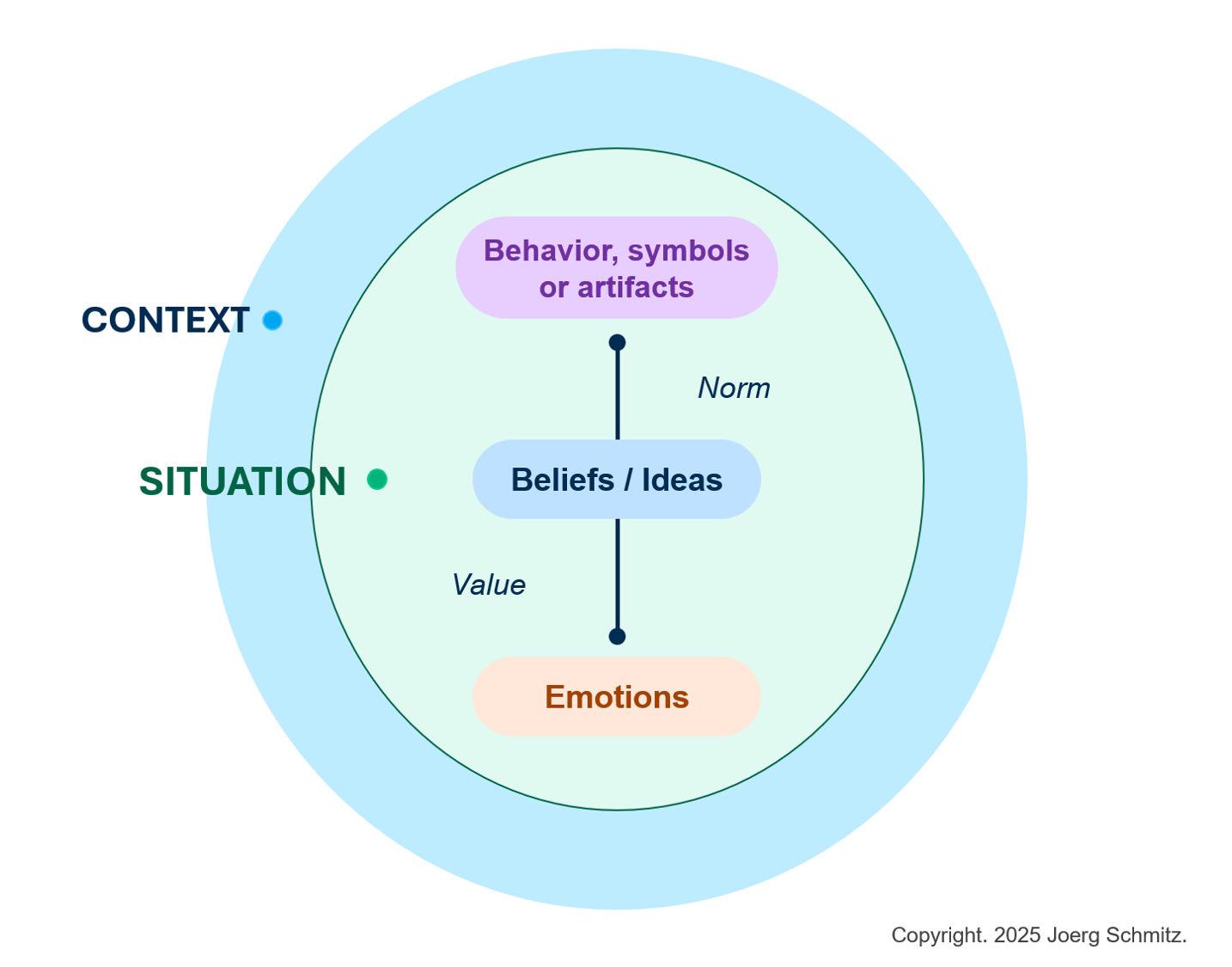
1. “The pattern of implicit associations between behaviors (and/or objects/artifacts), ideas or beliefs, and feelings/emotions… ”
This first element of the definition recognises an implicit association that becomes forged between external and expressive aspects - behaviors and things - and internal, experiential aspects - cognition and emotions. Here are two simple examples to illustrate this “cultural conditioning”:
Greetings. There are different conventions for greeting one another: shaking hands, bowing, waving a hand, putting a hand on the heart region, raising eyebrows, shaking head side to side, etc. Each is tied to a belief that acknowledging others - whether family, acquaintance, or stranger - is polite, good-mannered, and respectful. It is an act of recognition, acknowledgement that makes transitioning in and out of social situations easier. When we expect to be greeted and our presence and social status acknowledged, we have neutral to positive sensations and feelings. We feel accepted, assured, and valued. When we reciprocate, our systems synchronize and we establish a social connection that is associated with positive sensations.
Clothing/Attire. Our attire has social meaning and signals a lot more than fashion sense. It can signal identity and regional, ethnic, religious, socio-economic, and professional background, even when we are not aware of this or intending to signal it. The clothing and adornments we buy, choose and wear are material objects that are connected to a belief or concept we have of them and their meaning. When the clothing we wear works, i.e., when people react to them in expected ways, such as complimenting us on our good taste, associating us with a particular group, or assuring us that we “belong or fit in”, we register neutral to positive emotion. When social signals communicate the opposite, it can trigger severely negative emotions, including shame and embarrassment.
To me, the inclusion of emotion felt particularly important. I had always wondered why emotional expression, regulation, and synchronicity had not been emphasized more. That at this time emotions in general, and emotional intelligence in particular, were “discovered” in leadership circles made it easier to discuss and explore the emotional aspects of cultural conditioning.
The inclusion of norms and values
This definition also connects and explains two concepts that are essential when describing culture: norms and values.
A norm describes actual, observable behavior patterns that reflect (to some degree) what people believe they ought to do—the socially approved or expected behavior (also called injunctive norm). This means that associations between behavior and beliefs reveal norms - “what people do, what they say, and what they say they do” as ascribed to the American anthropologist Margaret Mead. This implies that, when studying culture, we must connect and compare: Actual behavior, public discourse, and the accounts people give about their behavior and the discourse.
A value is a deeply held belief about what is important, desirable, or morally right —what goals are worth pursuing, what modes of conduct are preferable, and what end-states we should strive toward. We value them, because there is an emotion attached to them:
When we and/or others act in accordance with them (e.g., helping a stranger if we value kindness), we experience positive emotions like pride, joy, or a warm sense of fulfillment and satisfaction. (value congruence)
When we and/or others betray or ignore our values (e.g., lying if we prize honesty), we often feel guilt, shame, anxiety, or a nagging sense of dissonance or we feel frustrated, angry and upset or outraged about the dissonance we observe in others.
Specific events, decisions, or issues - when related to them - can trigger strong emotions, such as anger at perceived injustice (fairness/value violation), grief at loss of a treasured relationship (love/value violation), and/or disappointment.
So, the implicit associations between behavior and belief encode norms, the implicit associations between beliefs and emotions encode values. From my perspective, it is critical to anchor the combination and relationship between norms and values, as organisations often treat them separately - either they build their culture through values or through behaviors, sometimes both and often without a deeper focus on norms.
2. “… that tends to be expected, reinforced and rewarded by and within a group.”
This essential addition channels the basic principles of classical and operant conditioning that underpin social learning. Classical conditioning is a learning process in which a neutral stimulus becomes associated with a meaningful stimulus, eventually eliciting a similar response. Operant conditioning, on the other hand, describes a learning process in which behavior is shaped by its consequences—either reinforced or sanctioned.
Many people, particularly in organizations, have a different understanding of expectation setting, reinforcement and rewards. What this definition suggests is not spelling out performance goals or reminding people of policies. Rewarding is not only about promotions, certificates, trophies, gifts, or bonuses. It mostly is much more subtle. An approving nod, a smile, a “good job” or any other form of communicating approval, for example. A surprising invitation to a meeting, the personal interest a leader takes in you and your career, can all be subtle forms of reinforcement and reward. Or perhaps differential attention by getting a little more or better information, being kept “in the know”, being solicited for input or advice, invited to attend certain types of meetings, opportunities to network with influential individuals, getting budgets approved without much scrutiny etc. All these reinforce desirable behavior and standards in an organization that employees learn from and norm to very quickly. Of course, the avoidance of behavior you know or assume to be negatively viewed and sanctioned also reinforces standards and norms. Avoiding negative commentary, ridicule, withdrawal of resources, including trust and confidence are powerful levers to create and perpetuate norms.
At times I have included “role modeling” as part of the definition, as in “expected, role-modeled, reinforced, and rewarded”. This explicitly acknowledges the role of imitation in cultural transmission. We frequently learn and adopt cultural norms by imitating others who we see as successful participants in a given cultural environment. But then on some level role modeling is a way of communicating expected behavior and reinforcing it, so I am still undecided whether to include it explicitly.
The emphasis that culture is a pattern of associations that tends to be expected, reinforced and rewarded is important. Recognising it as a tendency avoids determinism and acknowledges the dynamism and range that exists within any given group. It also acknowledges the quantum characteristics of culture discussed in the previous edition.
So, the base code of culture is articulated as the “pattern of implicit associations between behaviors (and/or objects/artifacts), ideas or beliefs, and feelings/emotions that tends to be expected, reinforced and rewarded by and within a group.”
This became the “long” definition. The short, easier and more intuitive one, was simply “culture is and/or becomes what is expected, rewarded and reinforced by and within a group.”
Context and situation matter, too
There was yet an additional aspect that needed to be acknowledged, namely the context and situation-dependency of cultural patterns. This is why Edward T. Hall has called the situation the “basic building block of culture.” The association of behavior-belief-emotion and their expression is always tied to context and situation. And, it is the cues embedded in context and situations that elicit the emotion-belief-behavior pattern in and among us.
The “collective programming” works on the basis of situation specific associations - in other words, it is a situational code. This is why:
We apply very different standards to our close friends, acquaintances and different types of strangers.
We behave differently across different social roles we inhabit. We show up differently as a concert goer, a visitor to a gallery opening, fellow rider in an elevator, panel participant, leader of a team, C-suite executive, or visitor of our grandparents in the hospital. Each of us knows the “rules” for these situations and seamlessly applies this knowledge (not always to conform, but also to resist, protest, or challenge). In doing so, each of us uses a wide spectrum (a repertoire) of styles and displays, as well as cognitive models and emotional ranges that reflect the norms and practices in the social environments that have shaped us and we have become familiar with as part of our biography.
This is why, for example, “high context” communication is not a curious style of communication that is found in “Asian” cultures as it is too often portrayed in “intercultural communication” sessions. Each of us applies and is highly attuned to high-context communication. Just think about the meaning you easily attribute and accurately read when your best friend or close colleague simply raises an eyebrow in a meeting you are both attending. The difference to fabled “Asian” cultures is simply that the situations, in which it is respectful, expected, and “normal” to communicate in a high context manner differ across social environments. And, of course, so does the symbolism and meaning used in the high context mode.
This has great implications for learning to navigate different social contexts and environments.
- Each of us already contains and is familiar with most of the cultural orientations that are commonly used to describe cultural differences. This means that differences are not categorical, but a matter of shifting associations and the emotional reaction and experience to them. In other words, the work of navigating across culture is not about learning new behaviors, but shifting the way we use familiar behaviors to different contexts and situations. The work is about detaching and reattaching the associations between behavior-beliefs-emotions we have internalized.
- We already possess and use the critical skills of style-switching. We can leverage that spectrum and behavioral repertoire we are already using to navigate cultural complexity and enable culture change.
- Navigating cultural contexts relies to a great extent on our ability to reflect and internalize a different pattern of subjective experience; in other words, it is a question of being able to internalize different maps that depict the worlds that others experience.
When understanding culture in this way the context and situation-specific associations serve as levers for cultural change. We can deliberately work together to shift our behavioral associations (together with our beliefs and emotions about them) in specific, previously identified ways.
The visual rendering of this understanding of culture that I have used in my work is the following:
A More Enabling Definition of Culture?
I hope you agree with me that this definition also anchors an entire methodology - one that enables (a) the description, analysis and comparison of cultures as well as (b) the architecting and implementation of intervention and change strategies. Especially because leaders are often keen on changing, merging and/or improving organization culture, it is important to leverage a sound and enabling understanding of a phenomenon that is as elusive and confounding as culture.
Why many culture efforts fail
Most “culture change” efforts fail because they focus on content (new values, new messaging) without changing the conditions that shape belief and behavior. All too often they are also not grounded in a good enough description of the existing culture. I have often been surprised how superficial and general leaders are in describing the culture of their organization.
For example: A company introduced a new value of “psychological safety” but continued to promote those who never challenged leadership. The behaviors of psychological safety were clearly misaligned with the newly espoused belief—and the emotional cost (and disincentive) of speaking up remained too high. Leaders often cited a meeting in the past where critical and challenging leaders were hunted and devoured “like antelopes by lions” by the C-suite.
What this new definition offers
By using this new definition of culture, we shift from surface-level alignment to deep pattern awareness:
- Are we reinforcing the behaviors we say we want? How are we disincentivizing the behaviors we say we want?
- Do the beliefs we promote match people’s emotional experience? Are they emotionally resonant? What, if anything gets in the way?
- Are there hidden rules, unspoken expectations, or emotional currents that override the formal ones?
Practical applications
These questions anchor key applications that are enabled by this definition - a systematic way to uncover cultural patterns and leadership strategies to change them.
- Behavioral Mapping. Ethnographic observation and conversations, behavioral journaling, or context-sensitive surveys can help uncover what’s actually going on—not just what people say they value or the opinions they register about the organization and its leaders. Mapping culture is after all not achieved through an opinion survey. It takes multiple types of data, but importantly qualitative insights that combine external and internal perspectives to identify what behaviors are expected, rewarded, or punished—formally and informally and how significant the gap between them is.
- Belief Auditing. Structured interviews, scenario testing, focus groups or sensemaking workshops can bring implicit and explicit beliefs and associated assumptions to light—especially across cultural or hierarchical divides. These may include beliefs about leadership, risk perception, the organization's mission or purpose, productivity, innovation, conflict, values, an acquired company, customers, or any other concern that requires change or seems relevant to enabling it.
- Emotional Climate Sensing. Reflective practices, feedback rituals, or emotional resonance tools can tap into the underlying affective atmosphere of a team or system. Ultimately, culture lives in the gut, not just the head. Emotions like fear, pride, guilt, and belonging shape how beliefs are enacted and habits are formed and/or changed.
Together, these levers reveal the cultural logic that underpins what is—and isn’t—possible inside a group.
They should inform a meta-reflexive process in which leaders are intricately involved - NOT as recipients of reports on the culture of the organization and recommendations for change. Leaders need to become actively involved in the data gathering, the sense-making, and action planning process. This is the essence of inclusive leadership as I understand it and connects leaders to the essence of leadership, namely the creation and shaping of culture.
Case Study: Applying this Understanding in a Merger
In a post-merger integration between two global firms, leadership tried to unify teams under a single “high performance” culture. But friction emerged between a legacy company known for its autonomy and another known for process rigor.
Rather than default to a culture war or generic training, the integration team used the “implicit connection” model:
- Behavior: In one firm, asking questions was rewarded; in the other, it was interpreted as dissent.
- Belief: One group believed initiative = value; the other believed conformity = trustworthiness.
- Emotion: One group felt pride in improvisation; the other felt anxiety when protocols were bypassed.
By surfacing these patterns, leaders stopped asking “How do we enforce a new culture?” and started asking “How do we negotiate shared meaning?” Change began not with top-down mandates, but with cross-group storytelling and peer recognition practices that aligned new behaviors with both belief systems. Most importantly, leaders showed up as fellow participants, facilitators and co-creators.
Parting Thought: Culture Is the Soil, Not the Seed
When we treat culture as something static to be “aligned” or “rolled out,” we miss the opportunity for real transformation. But when we see culture as the evolving connection between behavior, belief, and emotion—shaped by what we expect, reinforce, and reward—we create new ways to engage with complexity.
So next time you’re facing a cultural challenge of any type and at any level of social organization, don’t just change the posters or the playbook. Ask: What’s really being reinforced here? What’s emotionally at stake? And how might we create new connections between what people do, believe, and feel—together?
An earlier version of this article was originally published on LinkedIn as “Anthropologically speaking … how we understand "culture" matters (Part 2)" in June 2025.
About the Author
Joerg Schmitz is a business anthropologist passionate about exploring human behavior through the lens of anthropology and organizational culture. He is the founder and Managing Director of The Inclusive Leadership Institute (@TheInclusiveLeadershipInstitute). After 35 years living in the US and working with organizations and institutions globally, he currently resides in Bremen, Germany. Connect with him at [email protected] to continue the conversation.
