
Why Your New Hire Thrives or Fails
Dec 10, 2025Do you want to know why some hires thrive, why others disappear into sameness, and why some actually shift your culture?
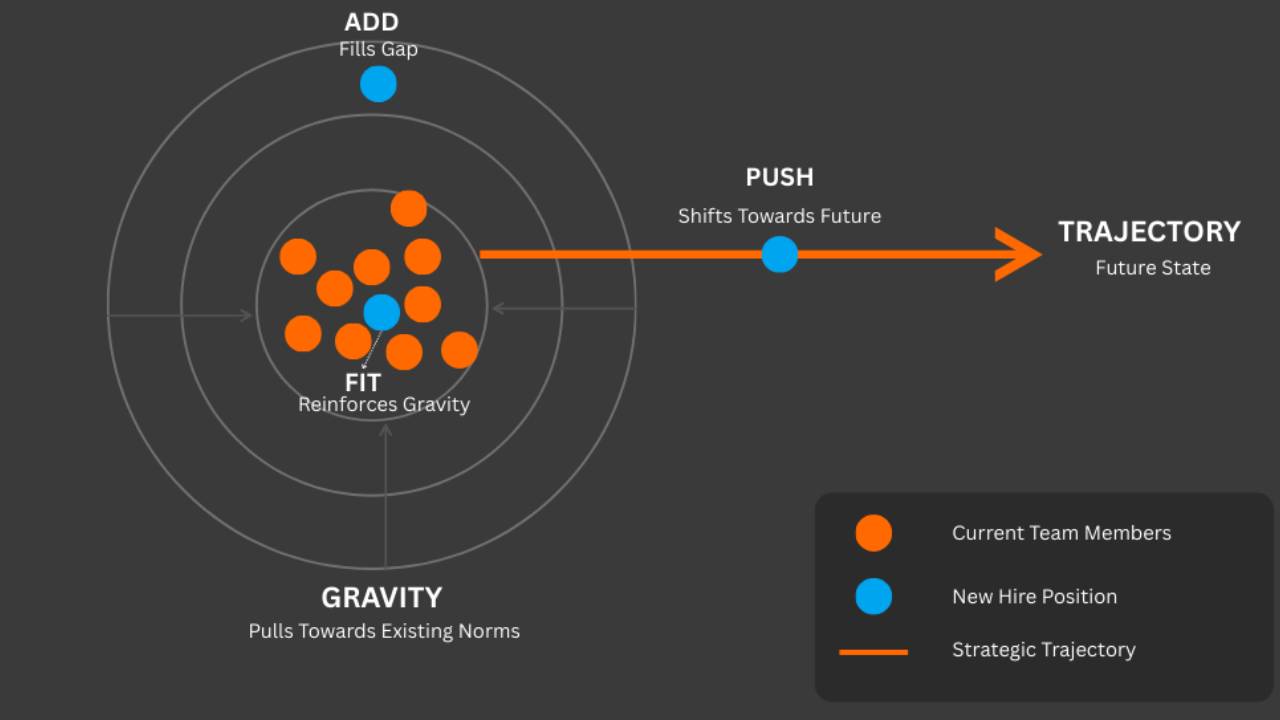
Two forces decide: gravity and trajectory.
Gravity: "How We Do Things Here"
Every team has a center of mass. Dominant habits, unspoken rules, and behavioral norms.
Gravity decides:
- How fast you move
- How open you are about conflict
- How decisions actually happen
- How much ambiguity you tolerate
It pulls everyone toward the norm. Not through enforcement but rather through human nature.
We gravitate toward existing patterns because they promise belonging.
This is why your "culture add" hire starts acting like everyone else after six months. They got absorbed.
Trajectory: Where You're Actually Headed
Trajectory is the direction your team / organization is moving, intentionally or not.
It's shaped by business demands, leadership signals, market shifts.
Examples:
- A startup drifting from chaos toward structure
- Mature organization shifting from caution to speed
- Team moving from transactional to relational
- Business unit going global because the market demands it
Trajectory explains why some hires bend culture even when outnumbered. They match the future you're already leaning toward.
With these two forces in mind, let's consider three common hiring moves (and how most leaders pick by accident, rather than intention).
Three Hiring Moves
1. Culture Fit = Reinforce Gravity
High-performing team. Task-oriented, direct, process-driven. You hire someone identical.
They slide in effortlessly. The team breathes a sigh of relief and thinks: "Finally! Someone who gets it."
Works when: Market is stable, you need execution not experimentation
Fails when: You need new thinking, environment has changed, you're stuck in old patterns
The cost: Blind spots calcify. Innovation dies. Team becomes fragile.
2. Culture Add = Fill The Gap
You're stuck with a visionary team that cannot operationalize ideas. So, you hire a systematic builder who creates structure.
Powerful if you design for it. Destructive if you don't.
Works when: You've diagnosed a real gap. The team will adapt and you end up protecting the newcomer from gravity
Fails when: You hired "diversity of thought" without knowing which thought or why.
The cost: Difference becomes a burden instead of capability.
3. Culture Push = Hire For Tomorrow
The team is too cautious. You hire someone who moves fast and decides early.
This is strategic. Directional. Trajectory made conscious.
Works when: Leadership names the shift explicitly.
Fails when: You outsource change to one hire.
The cost: Conflict without transformation.
What Happens Without Intent
- "Culture add" → becomes culture fit
- "Culture fit" → contributes nothing new
- "Culture push" → creates conflict, no change
- "Accidental hire" → cultural casualty
What You Actually Need
1. Map your gravity: How does your team actually work?
2. Define your trajectory: What direction supports your strategy?
3. Choose consciously: Fit, add, or push?
4. Prepare the team: Name what's changing.
This Is Where Teamscape® Helps
Teamscape makes gravity and/or the need for trajectory visible.
- How they interact
- How they engage resources
- How they make decisions
- How they solve problems
Then you hire with intent. And prepare your team for what comes next.
Learn more: www.theinclusiveleadershipinstitute.com/teamscape
